



The Complete Used Appliance Buying Guide: Key Considerations


If you’re searching for a used appliance right now, you’re making a smart move. New appliance prices are climbing and with tariffs pushing costs higher across the supply chain, buying used or refurbished is no longer just a budget decision but there is a right way and a wrong way to buy a used appliance. The right way saves you hundreds of dollars. The wrong way leaves you with a machine that breaks in six weeks and no one to call. This complete used appliance buying guide covers everything you need to know from understanding how long an appliance should last, to inspecting it properly, to getting a fair price at a trustworthy used appliance store near you. Whether you’re shopping for a refrigerator, washer, dryer, or range, read this before you spend a single dollar.
Quick Summary
- A used appliance is a great deal only when you verify performance, not just looks.
- Always calculate the full cost: price + delivery + installation + haul-away.
- Ask the seller what they tested. Vague answers are a red flag.
- For refrigerators: check cooling and door seals first.
- For washers and dryers: confirm spin, drainage, and heat output.
- For ranges: test every burner not just one.
- Buying from a local used appliance store gives you tested inventory, delivery options, and someone to call if something goes wrong.
Why Buy a Used Appliance?
The Savings Are Real
Prices on new appliances have gone up and they are likely going higher. Recent estimates from researchers at Yale’s Budget Lab suggest tariffs could add thousands to what the average household pays for new goods each year. A refrigerator that sold for $1,200 new can often be found used, tested, and delivered for $300 to
$600. A full washer and dryer set that would cost $1,500+ new can be yours for under $600 at a reputable used appliance store.
On average, used appliances sell for 50 to 75 percent off original retail price. That savings range is real but it depends on where you buy and whether the appliance has been properly inspected.
The Environmental Reason
Large appliances make up roughly 25 percent of all global e-waste electronics and plug-in goods discarded every year. That number is growing. Buying a good used appliance keeps a working machine in service and out of a landfill. It’s the most practical kind of recycling there is.
When Used Makes Sense
Used appliances are a great choice for refrigerators, ranges, stoves, washers, and dryers. These are sturdy machines with long lifespans and active resale markets.
Used appliances are harder to justify for dishwashers and microwaves. New dishwashers and microwaves are already relatively affordable, so second-hand appliance stores rarely stock them and when they do, the savings are minimal. For those two categories, open-box or scratch-and-dent units are usually a better route.
Open-Box vs. Used: What Is the Difference?
If you’re shopping for “good used appliances” online or in a store, you’ll run into both terms. They aren’t the same thing.
Open-box means the product was sold, the packaging was opened sometimes only to inspect it and then returned. The appliance itself may be essentially new, with little or no actual use. It may have minor cosmetic marks, and occasionally a non-essential accessory is missing. Performance is typically identical to new. The discount exists because the box was opened, not because the machine has been used.
Used means the appliance lived in someone’s home for some period of time. It has actual operating hours on it.
The machine may work perfectly many do, for years but it requires more careful inspection and honest disclosure from the seller about its condition and age.
City Appliances carries both types. Knowing which you’re looking at changes how you inspect it and what questions you should ask.
How Long Will It Last? (Appliance Life Expectancy)
This is the question most buyers forget to ask and it’s one of the most important numbers in the used appliance buying decision.
Here are the average useful lifespans according to the Association of Home Appliance Manufacturers (AHAM):
|
Appliance |
Average Lifespan |
|
Gas range |
15–17 years |
|
Electric range |
13–15 years |
|
Dryer |
~13 years |
|
Refrigerator |
9–13 years |
|
Washing machine |
5–15 years |
The Useful Life Math
Use these numbers to evaluate whether a price is fair. Here is how:
Say you’re looking at a used refrigerator with an average lifespan of 12 years, and it’s already 9 years old. That leaves roughly 3 years of expected life. A price of $150 might make sense. A price of $400 probably does not unless it has been professionally refurbished and comes with a meaningful warranty.
A good seller should be able to tell you the appliance’s age. If they cannot, you can find the manufacture date stamped on the serial number sticker, or look it up online using the model number.
The Exception to the Rule
Not every old appliance is a bad buy. Some models are legendary for durability. Whirlpool’s direct-drive top-load washing machines, built through the 1990s under brand names like Maytag, Kenmore, and Roper, are a good example. A professionally rebuilt version of one of those machines can realistically give you another 10 to 15 years of service. A good second-hand appliance store will tell you when they have something like that in stock and why. Choosing right appliance store is a crucial factor in this matter.
Available Used Appliances
Most used appliance stores carry ranges, refrigerators, washers, and dryers as their core inventory. Selection is smaller than a big-box storetypically 30 to 50 units at a time but inventory changes regularly. If you are looking for something specific, ask the store to call you when it comes in. The buyers who score the best deals check back often or leave their number.
Here is what to expect and inspect for each major category.
Used Refrigerators
Refrigerators are the most common find at any second-hand appliance shop, and they offer some of the best value when bought used. A French-door model that cost $1,800 new can be found for under $600 in good working condition.
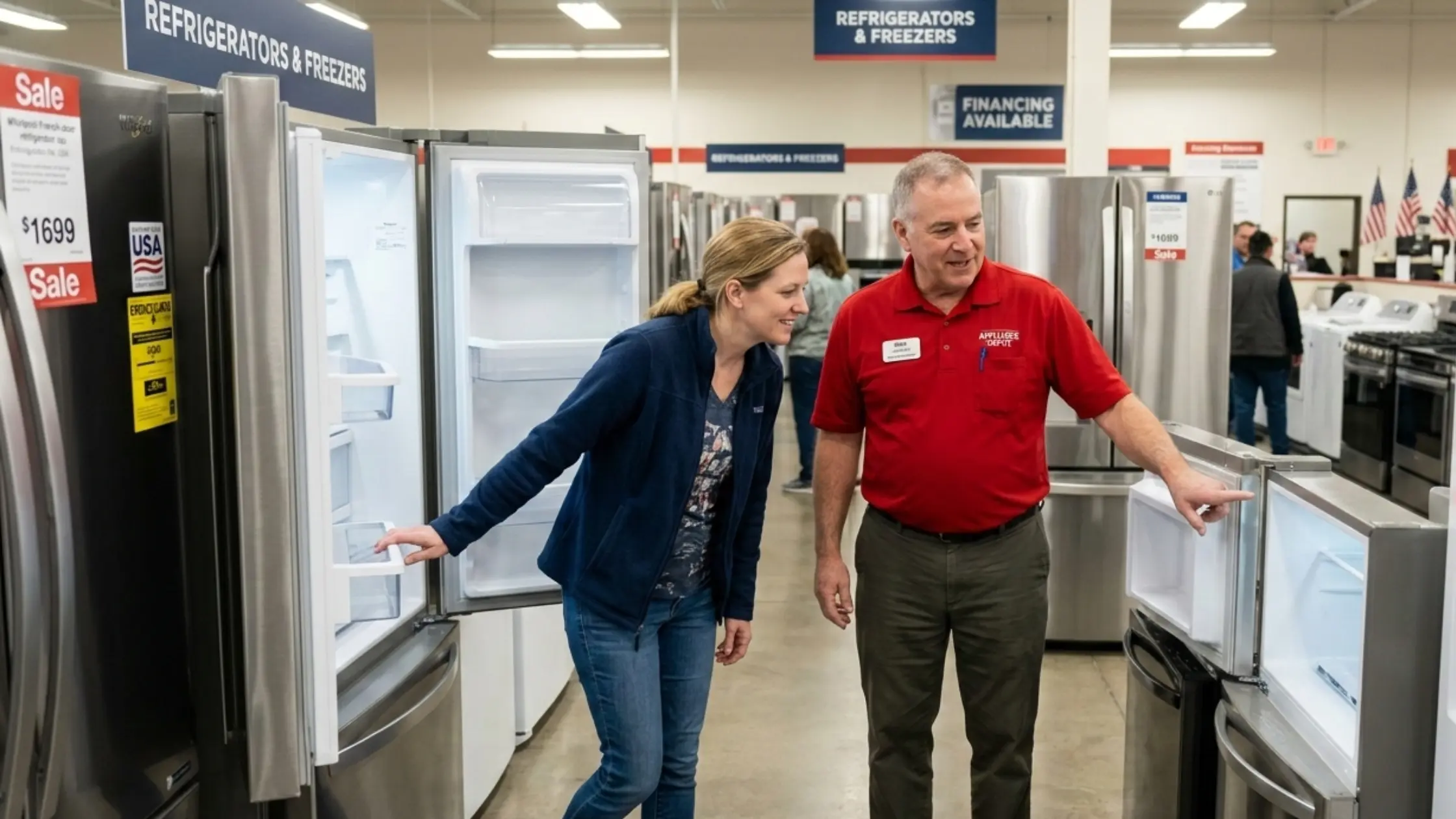
Styles you’ll typically find:
Top-freezer models: best value for budget buyers, proven simple mechanics
Side-by-side models: mid-range pricing, common in used inventory
Bottom-freezer and French-door models: higher price point even used, but large savings over new
What to inspect:
- Cooling consistency is the most important factor. Confirm the fridge compartment and freezer reach stable, separate temperatures.
- Door seals (gaskets) run your hand along the seal. It should be soft, flexible, and form a tight contact with the frame. A cracked or stiff seal lets warm air in and raises your energy bills.
- Compressor sound some hum is normal. Loud clicking, grinding, or knocking is not.
- Under the crisper drawers look for pooled water or staining that signals a defrost drain issue.
- Ice maker and water dispenser features add convenience but also add failure points. If the unit has one, test it. If it’s sold “as-is” and untested, factor that risk into the price.
- Smell a strong odor may not fully go away, even with cleaning.
- One rule you must follow for transport: If a refrigerator is laid on its side during delivery, the compressor lubricant migrates away from where it needs to be. Stand the fridge upright in your home and wait at least 24 hours before plugging it in. Skipping this step risks damaging the compressor immediately.
Used Ranges and Stoves
While most guides ignore used ranges, they offer some of the best value for Sacramento homeowners. A gas range that sells for $900 new can often be found used for $200 to $350 in good working order.
What to Inspect In Gas ranges :
- Every burner must ignite. Test them one by one. A stable blue flame is what you want.
- Check the burner ports. Clogged ports mean poor performance and hard cleaning ahead.
- They also tell you how well the previous owner maintained the appliance.
- Test the oven. Use a thermometer if you can confirm it holds a set temperature accurately.
- Look at the ignition wires. Frayed or damaged wires are a safety concern and a dealbreaker.
What to inspect in Electric Ranges:
- Every burner element should glow red and heat evenly. A slow or uneven element is failing.
- Glass-top stoves: look closely for cracks. A cracked glass cooktop is a safety hazard don’t buy it regardless of price.
- Confirm the oven door seal is intact and the door closes flush.
Both types:
- Open the oven door and check for heavy grease buildup inside. Some is normal.
- Thick carbon buildup that has been baked on suggests years of neglect and may affect performance.
- Confirm all knobs and controls function. Stuck or stripped knobs are a hassle and sometimes a safety issue.
Used Washers and Dryers
Laundry appliances are among the most purchased used items in Sacramento because buying locally reduces the risk of transport damageand the savings on a matched set are significant.
Used washer inspection checklist
- Run a short cycle and watch it. The machine should fill, agitate, drain, and spin without excessive vibration.
- Check the spin cycle serious shaking often means suspension problems.
- Inspect under the machine and around the hose connections for signs of leaking.
- For front-load washers: pull back the rubber door gasket and look underneath it. Mold inside the gasket seal is a common problem and can be very difficult to fully remove.
- Check the lid or door lock. The machine won’t spin if the lock does not engage test it.
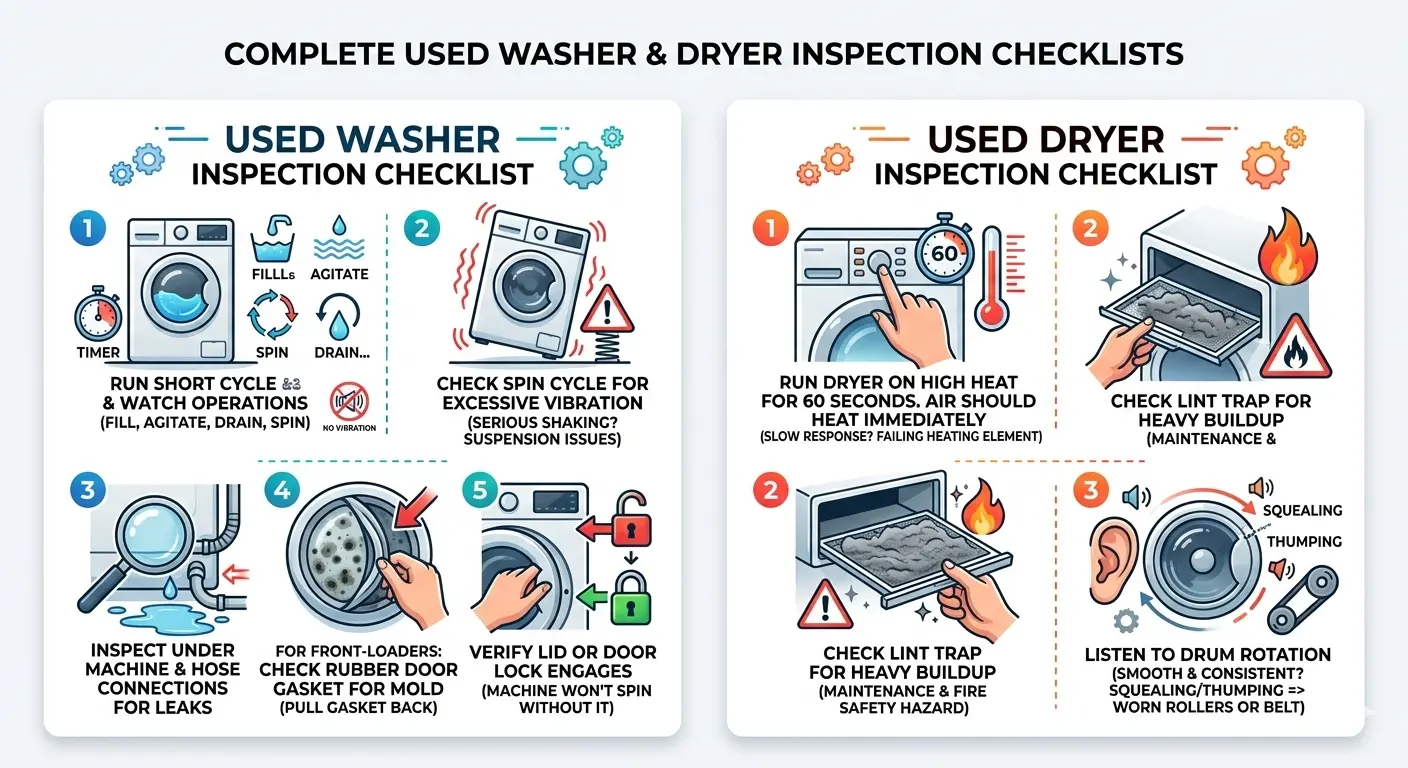
Used dryer inspection checklist
- Run the dryer on high heat for 60 seconds. The air inside should heat immediately. A slow or absent heat response often means a failing heating element.
- Open the lint trap area and check for heavy buildup. Excessive lint buildup is both a maintenance issue and a fire safety concern.
- Listen to the drum rotation. It should be smooth and consistent. Squealing or thumping suggests worn rollers or a belt.
Why buying a washer and dryer set usually makes sense: Matching capacity between the two units means your dryer can handle everything the washer just cleaned in one cycle. Delivery and installation is simpler with a set. And pricing is almost always better when you buy both together from the same storeCity Appliances regularly offers better bundle value than buying each separately.
Used Dishwashers
Refurbished appliance stores rarely carry dishwashers. The reason is simple: new dishwashers are already priced low enough that shop owners cannot make a margin on them secondhand. When you do find one at a second hand appliance shop, the savings over new may not justify the unknowns.
If you need a dishwasher, open-box or scratch-and-dent is almost always the better path. You get near-new performance at a meaningful discount without the inspection risk of a used unit.
If you do evaluate a used dishwasher:
- Check the spray arms for clogs. Blocked spray arms mean poor cleaning.
- Run it through a full cycle and confirm it drains completely at the end.
- Inspect the racks for missing rollers or rustreplacement parts for specific models can be surprisingly hard to source.
Used Microwaves
Like dishwashers, used microwaves are rarely worth the search. New countertop microwaves are inexpensive enough that the hassle of sourcing and inspecting a used one usually outweighs the savings.
The one exception is over-the-range models, which are more expensive new and involve a fixed installation. If you find one that fits your space, has been tested, and is priced appropriately, it may be worth considering. Confirm the ventilation fan works, the light works, and the turntable rotates smoothly.
Where to Buy Used Appliances in Sacramento
Where you buy matters as much as what you buy. The same refrigerator purchased from a reputable local store versus a private Facebook listing represents a very different level of risk.
Local Used Appliance Stores
A dedicated used appliance store like City Appliances in Citrus Heights gives you tested inventory, a real warranty, delivery options, and a phone number to call if something goes wrong. Prices may not be the absolute lowest sticker price, but the total value (tested machine + delivery + accountability) is consistently better than the alternatives. Look for stores where technicians inspect appliances before they go on the floor. That means checking temperatures, motor speeds, switches, hose integrity, and known high-failure points for specific models. Ask what their process is. A good store should tell you without hesitation.
Thrift Stores and Nonprofits
Organizations like Habitat for Humanity ReStore carry donated appliances at competitive prices, and some offer a 30-day return guarantee. What you sacrifice is depth of inspection most thrift sellers aren’t appliance technicians. “We plugged it in and it turned on” is a different level of testing than what a dedicated repair shop provides. That said, sharp buyers have found excellent deals at thrift stores. If you know what to inspect and the price is right, it can work out well.
Private Sellers (Facebook Marketplace, Craigslist)
Private sellers offer the lowest sticker prices and the highest risk. There is no warranty. There is no recourse if the machine fails the day after delivery. you’re typically responsible for your own transport, and moving an appliance incorrectly can damage it before you even get it home. For lower-stakes items, private sellers can work. For major appliances where installation is involved and failure is costly, the risk is rarely worth chasing the lowest price.
What a Real Warranty Looks Like
Any reputable second-hand appliance store should provide a written warranty. Here is what it should include:
- Coverage of both parts and labor not just one.
- A term of at least 30 to 90 days (some good shops offer up to 6 months).
- Clear language about what is and is not covered.
- A physical copy handed to you at purchase.
If a seller cannot explain their warranty in plain terms, that is a signal. A warranty you have to argue about to use is not a real warranty.
How to Research an Appliance Before You Buy
Knowing how to look up an appliance before paying for it takes five minutes and can save you from a costly mistake.
Step 1: Find the manufacturer’s sticker
It’s usually on the door jamb, inside the door frame, or on the back or side panel. Every legitimate appliance has one. If there is no sticker, walk away the appliance may have been recalled and illegally salvaged.
Step 2: Write down the model number and serial number
You need both.
Step 3: Check for safety recalls
Go to the U.S. Consumer Product Safety Commission database at cpsc.gov and search the model number. Some appliances have been recalled for fire hazards, electrical failures, or other safety issues. This check takes two minutes and is non-negotiable.
Step 4: Find the manufacture date
It may be stamped directly on the sticker. If not, most manufacturers
encode the date in the serial number a quick online search for your brand’s serial number decoder will give you the exact date. Use the AHAM lifespan estimates in3 to calculate how much useful life remains.
Step 5: Check parts availability
Search repairclinic.com for your model number. If the parts for that machine are no longer available, a repair down the road may be impossible. This matters more for older or discontinued models.
Step 6: Download the owner’s manual
Used appliances rarely come with manuals, but manufacturers post them online. Search your model number and download it before you buy it tells you what accessories and removable parts should be present (shelves, drawers, racks), so you can confirm everything is accounted for.
Questions to Ask the Seller Before You Pay
A good seller will answer these questions clearly. Hesitation or vague answers tell you something important.
About the appliance’s history:
- What did your inspection include?
- Were any parts replaced? If so, were they OEM (original manufacturer parts) or generic?
- What common failure points did you check for in this model?
About the machine’s condition:
- How old is this appliance? (Cross-check with the serial number sticker.)
- Has it had any repairs done before it came to you?
- Is there anything about this unit I should know before buying?
About your protection after purchase:
- What does your warranty coverparts, labor, or both?
- How long is the warranty period?
- What is the return or exchange process if there is a problem?
About logistics:
- Is delivery available, and what does it include?
- Do you disconnect and haul away my old appliance?
- Are installation hookups included or separate?
Negotiation: It’s Expected
Haggling at a second-hand appliance store is not rudeit’s expected. Most sellers have flexibility, especially in the following situations:
You pay in cash. Cash saves the seller transaction fees and is often worth an immediate discount.
You take it today. A unit off the showroom floor immediately is worth something to the seller. Asking for 10 percent off when you can take it same-day is a reasonable conversation.
You buy more than one item. A washer and dryer together, or a refrigerator and range bundle pricing is common and almost always available if you ask.
There is cosmetic damage. Dents and scratches don’t affect performance. If you don’t care about them, you shouldn’t pay full price for them.
At City Appliances, we’re a local family-owned business you’re talking to a real person, not a corporate policy. That conversation is always open.
The True Total Cost
The sticker price is only part of what you’ll spend. Before you decide a deal is good, add up the real total:
Real total = appliance price + delivery + installation + haul-away
Here is what those costs typically look like:
Delivery: $25 to $200 depends on distance and service
Range installation: approximately $105 to $125 (when gas lines and connections are in place)
Washer installation: approximately $50 to $175 (when hookups and venting are in place)
Gas line or dryer vent hookup: don’t DIY unless you’re qualifiedhire an appliance professional
Then compare that total to the alternative: the cost of repairing your current appliance. In many cases, a $250 used refrigerator fully delivered and installed beats a $350 repair on a 10-year-old machine that may fail again. One important note on gas appliances: if you don’t know how to connect gas lines or a dryer vent safely, don’t attempt it. Hire a licensed appliance professional. The cost is modest, and the safety difference is significant.
Energy Efficiency: Does It Matter for Used Appliances?
Yes and it matters more in Sacramento than in many other cities. PG&E rates mean that an energy-hungry old refrigerator or washing machine can add $15 to $40 per month to your bill compared to an efficient model. Over a year, that difference can exceed $300. An energy-efficient used appliance can cost more upfront and still come out ahead over two or three years of ownership.
What to look for:
- The Energy Star label on the appliance’s data sticker, or look up the model number online
- For refrigerators: models with better insulation and tighter seals use less energy even when older
- For washers: front-load models typically use significantly less water than top-load counterparts
- Even among used appliances, efficiency differences are real and worth checking. Ask City Appliances about energy ratings when you’re comparing models.
Brand Reliability: A Quick Reference for Used Appliance Shoppers
Not all brands age the same way. Consumer survey data consistently shows that some brands are more reliable than others across the first five years of ownershipand those reliability patterns tend to hold in used appliances too.
Brands with strong reliability records across multiple categories include: Bosch (especially dishwashers), LG, and Samsung for refrigerators. Whirlpool and Maytag have solid track records for washers and dryers, particularly older direct-drive models.
Brands worth more careful inspection when buying used: Viking looks impressive but has a weaker reliability record for ranges in consumer surveys. GE Profile performs well overall but has known compressor issues in some refrigerator lines.
The most important rule: brand reputation is a guide, not a guarantee. A well-maintained appliance from a less-favored brand may outperform a neglected unit from a top-rated one. What matters most is the specific machine in front of you and the quality of the inspection it received before it was put up for sale.
Common Mistakes Sacramento Buyers Make
Buying based on appearance only. A shiny exterior tells you nothing about cooling performance, drum balance, or heating element function. A few scratches on a fully tested machine beats a spotless appliance no one has checked.
Skipping the door seal check on refrigerators. A failed gasket raises your energy bill and strains the compressor. It’s one of the fastest things to inspect and one of the most commonly overlooked.
Not checking the spin and drain on washers. A washer that fills and agitates but does not drain or spin properly is not functional. Always run a partial cycle before buying.
Forgetting to budget for delivery and installation. The cheapest appliance in the city is not the best deal if the transport and setup cost more than the machine.
Choosing “as-is” without understanding what that means. “As-is” means no warranty and no recourse. For a $75 microwave, that risk is manageable. For a $400 refrigerator, it may not be.
Ignoring the age. A $300 refrigerator that is already 11 years old with a 12-year average lifespan may give you one more year of use. That is not a bargain that is a rental.
Your Pre-Purchase Checklist
Before you hand over any money, confirm the following:
About the appliance:
- Model number and serial number located
- Manufacture date confirmeduseful life calculated
- Safety recall check completed (cpsc.gov)
- Parts availability confirmed (repairclinic.com)
- Core function tested (cooling / spinning / heating)
- Door seals inspected
- No frayed cords, cracked glass, or rust in critical areas
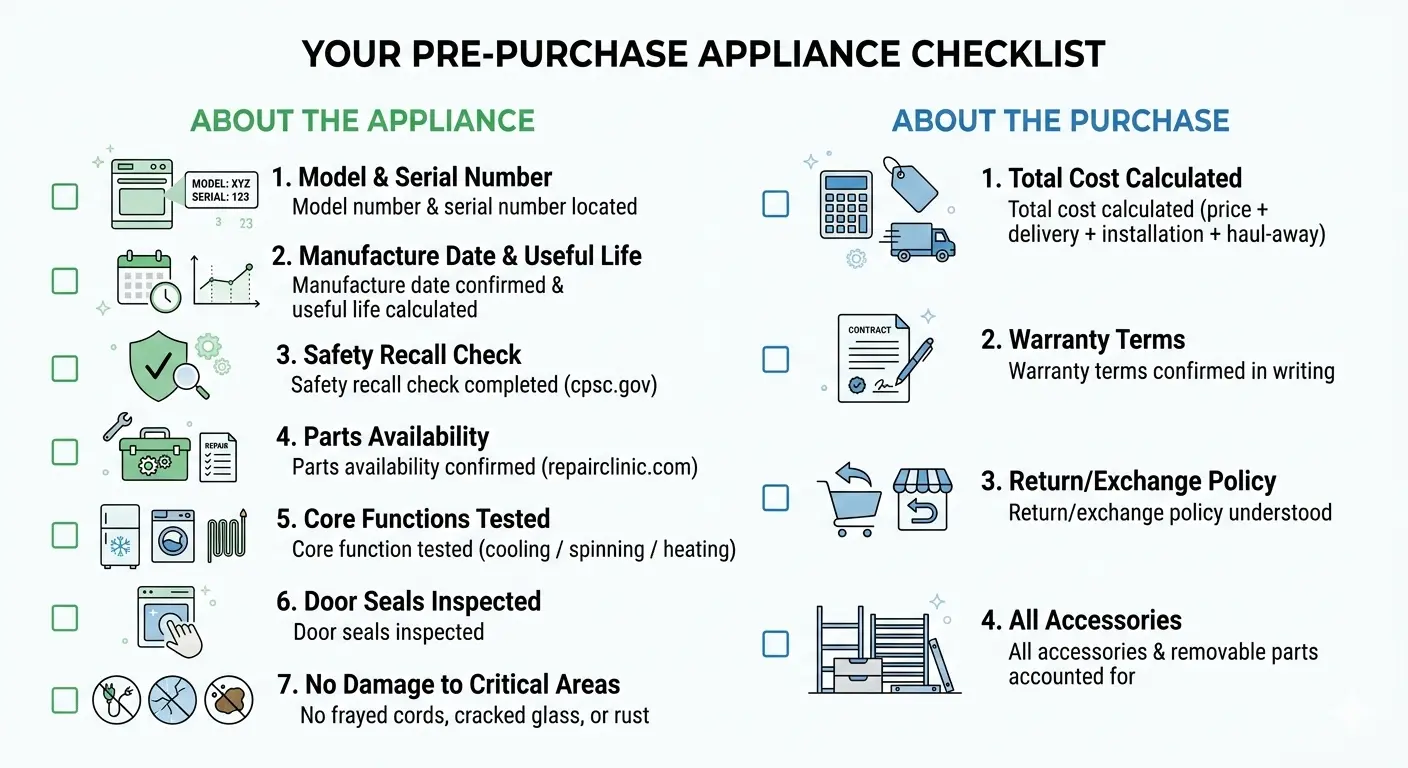
About the purchase:
- Total cost calculated (price + delivery + installation + haul-away)
- Warranty terms confirmed in writing
- Return/exchange policy understood
- All accessories and removable parts accounted for
Why Buy From City Appliances in Citrus Heights?
We hope this used appliance buying guide will be insightful for you. City Appliances is a local, family-owned, licensed appliance store serving Sacramento, Citrus Heights, and the surrounding area. Here is what that means for you:
Tested inventory. Every appliance on our floor has been inspected. We can tell you what was checked, what was replaced, and what to expect.
Honest condition grading. We don’t hide cosmetic damage or performance issues. You know what you’re buying before you pay.
Same-day and next-day delivery available throughout the Sacramento metro area, including Citrus Heights.
Haul-away included we take your old appliance when we deliver your new one, at no added hassle to you.
You talk to a real person. We’re not a call center or a corporate policy. Come in, call us, and we will help you find the right appliance for your home and your budget.
Visit us at 8038 Greenback Ln, Citrus Heights, CA 95610
Call Now at +1 916-501-6182
Time: Monday–Sunday, 8am–6pm
Frequently Asked Questions
Q 1: Should I be worried about mold when buying a used front-load washer?
Yes. Check the rubber door gasket for visible black mold or musty smells; ensure the price reflects any cleaning or replacement needed.
Q 2: Can I bring a used appliance back if it stops working a week after I buy it?
Private sales are usually as-is, but reputable stores typically offer 30 to 90-day written warranties covering parts and labor.
Q 3: What is the difference between a refurbished appliance and a used one?
Used units are tested and cleaned, while refurbished units have high-wear components proactively replaced with new parts.
Q 4: What appliance brands hold up the longest when bought used?
Reliability varies by type (e.g., Whirlpool/Maytag for washers, LG/Bosch for fridges), but part availability is the most critical factor for longevity.
Q 5: Is it worth buying a used appliance if I am renting?
Yes, if you stay 12–18 months, ensure it’s transported correctly to avoid damage during your next move.
Q 6: How do I know if a used appliance has been recalled for safety reasons?
Search the model and serial number at cpsc.gov; if the identification sticker is missing, don’t purchase the unit.