


Why agitator washers are better for heavily soiled clothes: best used picks in Citrus Heights

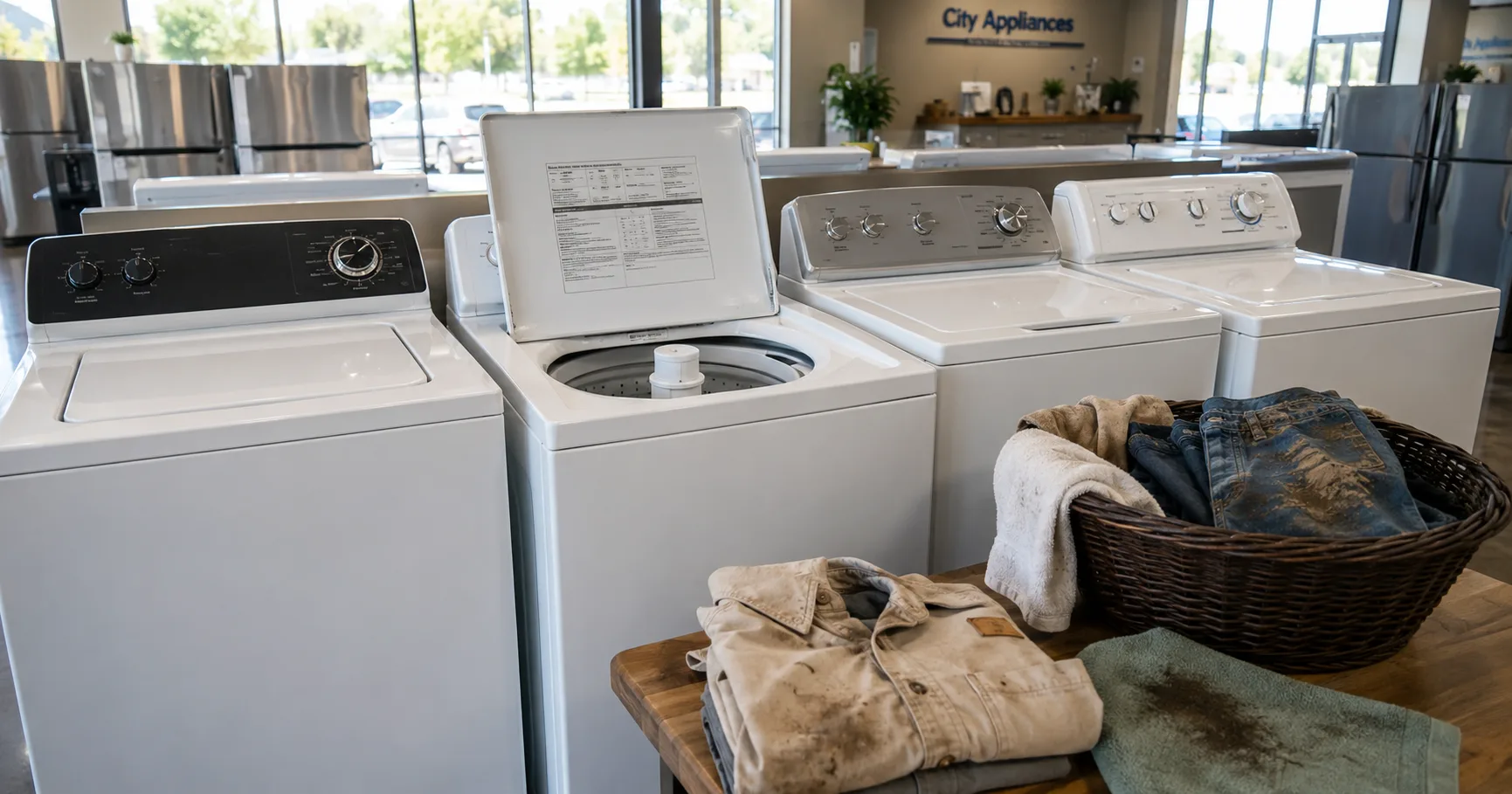
An agitator washer’s center post scrubs clothes against each other with direct mechanical force that neither an impeller disc nor a front-load drum can fully match. That extra friction is why agitator washers still win on ground-in dirt, muddy work clothes, and heavy sports gear, even though impeller and front-load machines are gentler and more water-efficient for everyday laundry.
TL;DR
- Agitator washers clean heavily soiled loads better than impeller or front-load machines because of direct mechanical scrubbing. They use more water and are rougher on delicate fabrics.
- LG, GE Profile, and Speed Queen are the most reliable agitator brands. Buying used can save 40 to 60 percent if you check the right things first.
- City Appliances stocks inspected used and scratch-and-dent agitator washers in Citrus Heights, typically $400 to $550 versus $900 new. Call or text (916) 501-6182.
How an agitator actually breaks down ground-in dirt
An agitator washer’s tall center post twists back and forth inside the drum. It physically drags clothes through soapy water instead of just letting water flow past them.
That back-and-forth motion rubs fabric against fabric and against the post’s fins. It creates direct friction that lifts dirt particles out of the weave rather than just loosening them.
This is different from the other two common washer types. An impeller washer uses a low-profile disc at the bottom of the tub that spins to create a strong water current, pulling clothes through more gently. A front-load washer tumbles clothes on a horizontal axis, lifting and dropping them through the water repeatedly. Both clean effectively for regular loads, but neither applies the same mechanical scrubbing an agitator does.
That distinction matters most when the dirt is worked into the fabric, not just sitting on the surface. Mud from a Sacramento backyard, grease from a work shift, or grass stains from a Saturday game sit deeper in the weave than everyday sweat or light soil. Detergent chemistry can only do so much on its own. At some point the wash needs mechanical force to physically push that soil back out.
For a broader look at how agitator washers compare to front-load models on everyday laundry, see our front load vs top load washer guide.
Agitator vs. impeller vs. front load: which wins on heavy soil
For everyday laundry, an impeller or front-load washer usually cleans as well as or better than an agitator while using less water. For heavily soiled loads, an agitator’s direct scrubbing still has the edge.
| Agitator | Impeller | Front load | |
| Cleaning method | Center post scrubs clothes directly | Low-profile disc creates a water current | Horizontal drum tumbles clothes through water |
| Best for | Heavily soiled, ground-in dirt | Everyday loads, bulky items | Everyday loads, fabric care |
| Water use per load | Highest | Moderate | Lowest |
| Fabric wear | Highest | Moderate | Lowest |
| Typical new price | Lowest, often $700 or less | Mid-range | Highest |
| Usable drum space | Reduced (post takes up room) | Largest | Large |
According to Consumer Reports testing, front-load washers outperform both top-load types in most cleaning tests. Modern high-efficiency impeller machines now clean better on average than traditional agitators too. So an agitator isn’t the best all-around choice.
Where it still wins is the specific case this article is about: laundry that’s genuinely dirty, not just worn once. Consumer Reports also notes that top-load agitator washers typically use 20 gallons of water or more per load. That’s the tradeoff for the scrubbing power.
If you’re weighing all three types side by side, it helps to see them in person. You can browse current top-load and front-load washers at City Appliances and test the difference in drum space yourself.
The tradeoffs: what you give up for that cleaning power
An agitator washer trades efficiency for cleaning power. It uses more water and electricity per load, is rougher on delicate fabrics, and holds less laundry than an impeller machine of the same size.
Water usage is the biggest gap. A standard agitator cycle can use 20 gallons or more, compared to roughly half that in a modern HE machine. Most of that water gets heated at some point, so the cost isn’t just on your water bill. In Citrus Heights, where PG&E rates have climbed over the past couple of years, that difference adds up. Our breakdown of PG&E bill increases and which appliance upgrades actually help covers this in more detail.
Fabric wear is the second tradeoff. The same friction that lifts dirt out of denim also stresses fibers over hundreds of cycles. Delicate items and fitted knits will show wear faster in an agitator than in an impeller or front-load machine. For work clothes and towels, that’s rarely a dealbreaker.
Capacity is the third. Because the agitator post sits in the middle of the drum, a machine rated at 4.5 cubic feet doesn’t hold as much loose laundry as an impeller washer with the same rating. Bulky items like comforters can end up tangled around the post.
None of this means an agitator is the wrong choice. It means the decision comes down to what you’re washing most often.
Buying a used agitator washer: what to check before you buy
Before buying a used agitator washer, run a test cycle, check the agitator post for cracks or wobble, inspect the tub for rust, and confirm the warranty.
A few minutes of checking saves you from buying someone else’s problem:
- Run a full wash and spin cycle if possible. Listen for grinding or screeching, which usually points to worn bearings.
- Check the agitator post itself. Fins should be intact, not cracked, and the post shouldn’t wobble at the base.
- Look inside the tub and around the gasket for rust, especially near the drain. Surface rust on unpainted metal is usually cosmetic. Rust near electronics or water inlets is a warning sign.
- Confirm the warranty type. A refurbished unit typically carries a shorter store warranty. A scratch-and-dent unit that’s new but cosmetically damaged usually keeps the full manufacturer warranty.
- Check the serial number for production age. A one or two-year-old unit is a different risk than one that’s sat in storage for five.
This is the short version. Our full scratch-and-dent and used appliance inspection guide walks through all fourteen checks we use before anything goes on our floor.
Which brands hold up best in a used agitator washer
For top-load agitator washers, brand matters more than any single feature. According to service data from Yale Appliance, based on over 33,000 real repair calls, LG top-load washers had the lowest service rate at 3.2 percent. GE Profile followed at 3.4 percent, and Speed Queen at 4.6 percent. The industry average was 4.4 percent.
Speed Queen’s slightly higher service rate comes with a tradeoff worth knowing. Its TC5 and TR7 top-load models carry 5 to 7 year parts and labor warranties, well beyond what most other brands offer. That’s part of why Speed Queen has built its reputation on durability over decades rather than low first-year service calls.
For a used purchase, this matters even more than it does when buying new. A machine that was well-built to begin with is more likely to have held up through its first life before it reaches our floor. LG, GE Profile, Whirlpool, and Speed Queen, all brands we regularly carry, are worth prioritizing when comparing used agitator washers.
Best used agitator washer picks at City Appliances in Citrus Heights
Since inventory changes week to week, the honest answer to “what should I buy” is less about a fixed model list and more about which brands to prioritize.
Our rotation of new, scratch-and-dent, and refurbished laundry includes Whirlpool, LG, GE, Maytag, and Speed Queen agitator top-load washers. Here’s how to think about them:
Speed Queen agitator models are the strongest pick if your laundry is genuinely heavy: work uniforms, muddy loads, or daily use in a busy household. The longer warranty and commercial-grade build carry over well into a used unit’s second life.
Whirlpool and Maytag agitator models are a solid middle ground. Parts are widely available and inexpensive, keeping repair costs down.
LG and GE Profile agitator models, when in stock, are worth prioritizing for the lowest service rate combined with agitator-level cleaning power.
Because what’s on the floor changes regularly, the fastest way to see current inventory is to call or text (916) 501-6182 or check our top-load washer listings before making the trip out.
What a used agitator washer actually costs in Citrus Heights
A used or scratch-and-dent top-load agitator washer at City Appliances typically runs $400 to $550, compared to roughly $900 for the same washer new. That’s a savings of $350 to $500.
The price depends on the category. A new scratch-and-dent unit, cosmetically damaged but never used, keeps the full manufacturer warranty and sits at the higher end of that range. A refurbished unit that’s actually been used carries a 60-day store warranty and is often priced a bit lower, depending on age and condition. Our guide to refurbished versus scratch-and-dent appliances breaks down that difference.
If financing makes more sense, City Appliances offers financing up to $5,000 on any purchase, new or used.
When an agitator isn’t the right call
Skip the agitator if you mostly wash delicates, bedding, or large comforters, or if your household deals with normal, everyday soil rather than heavy work clothes and mud.
An impeller washer holds more in the drum and is gentler on fabric, which makes it a better fit for families doing mostly regular laundry. A front-load washer wins on long-term water and energy costs if that’s the bigger priority for your household.
If most of your laundry is everyday wear rather than heavy soil, our full breakdown of front load vs top load washers digs into which type actually fits typical family laundry better.
Ready to see what’s on the floor?
Heavily soiled laundry needs a washer that can actually keep up, and the fastest way to find the right one is to see what’s currently in stock. Our team can walk you through which agitator models are on the floor today, what condition they’re in, and which brand fits how you actually do laundry.
City Appliances
8038 Greenback Ln, Citrus Heights, CA 95610
📞 Call or text: (916) 501-6182
Find us on Google Maps: https://share.google/m9flWoSAxGTIJlQbi
Whether you’re after this exact washer or need help matching a used agitator model to your household’s laundry needs, our team is ready to help. Stop by, call, or text anytime and we’ll walk you through what’s currently in stock.
Frequently asked questions
Q1: Are agitator washers actually better for heavily soiled clothes?
Yes, for genuinely dirty loads like mud, grease, or work uniforms, an agitator’s mechanical scrubbing outperforms impeller and front-load machines. For everyday laundry, impeller and front-load models generally clean as well or better while using less water.
Q2: Are agitator washers rough on clothes?
They’re rougher than impeller or front-load machines because of the direct friction against fabric. For durable items like work clothes and towels, that’s rarely an issue. For delicates, it can speed up wear.
Q3: What’s the most reliable brand for a used agitator washer?
Based on real service data, LG and GE Profile top-load washers have the lowest repair rates. Speed Queen has a slightly higher service rate but the longest warranty coverage.
Q4: How much should I expect to pay for a used agitator washer in Citrus Heights?
At City Appliances, used and scratch-and-dent top-load washers typically run $400 to $550, compared to about $900 new, depending on brand and condition.
Q5: How do I clean mold or odor out of an agitator washer?
Run an empty hot-water cycle with a washer cleaner or a cup of white vinegar, then wipe down the agitator post and lid area. Agitator washers are less prone to mold than front-load models since there’s no door gasket trapping water.
Q6: Where can I buy a used agitator washer near Citrus Heights?
City Appliances carries a rotating selection of used, refurbished, and scratch-and-dent agitator washers from brands like Whirlpool, LG, and Speed Queen. Call or text (916) 501-6182 for current availability.