



Can a countertop microwave be installed as a built-in? What Sacramento buyers should know

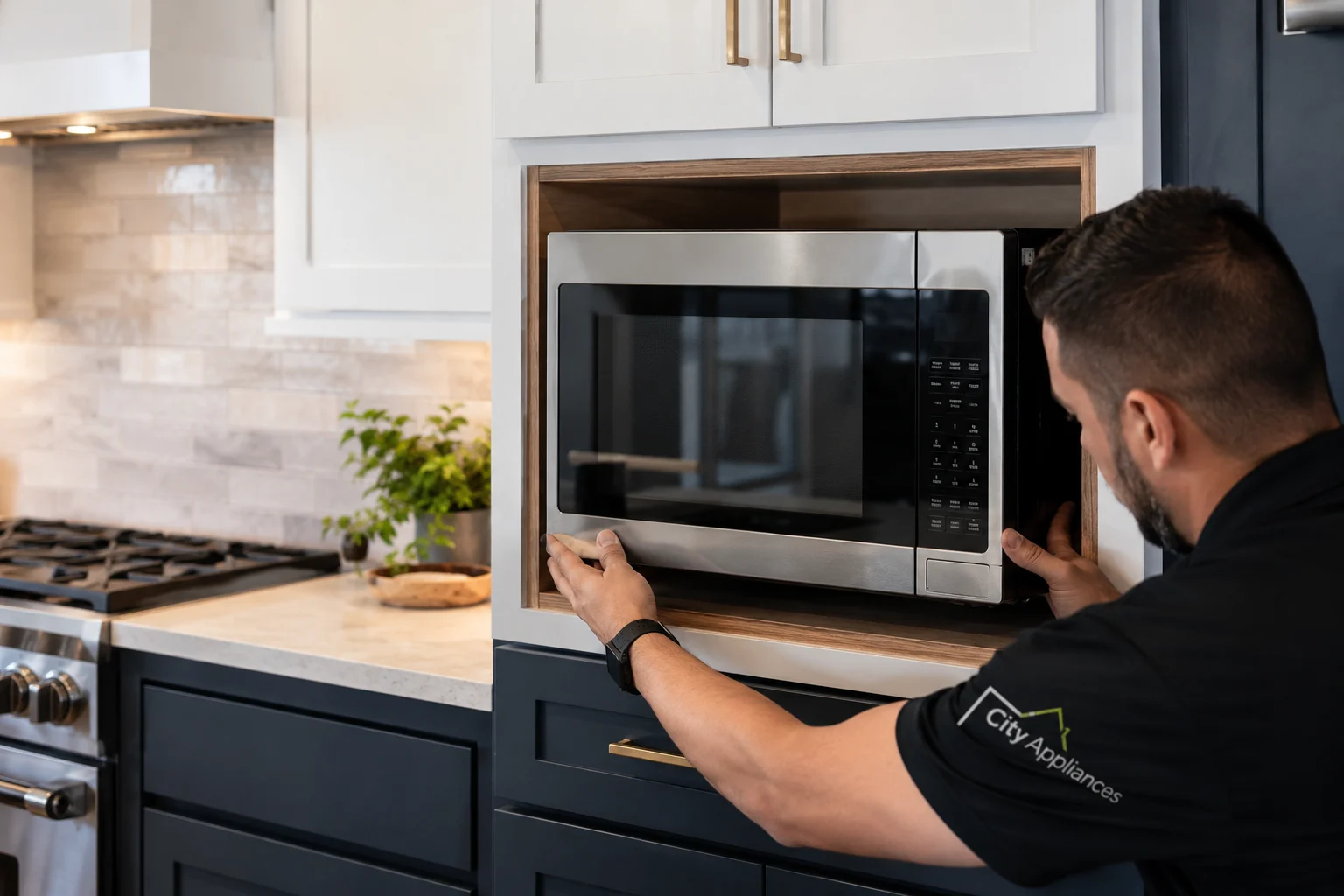
TL;DR
- Only certain countertop microwave models have a manufacturer trim kit available. No trim kit means no safe built-in conversion, no matter how well it looks like it might fit.
- A built-in microwave body typically needs a cabinet opening around 21⅞ inches deep, plus a dedicated 120-volt circuit. A standard 12-inch wall cabinet won’t work; you need a tall cabinet or a dedicated opening.
- Converting with a trim kit runs $220 to $580 in labor nationally, while a dedicated built-in unit costs $400 to $2,000. Compare both before you buy. Questions? Call or text City Appliances at (916) 501-6182.
Can a countertop microwave really be built into a cabinet?
Yes, but only for specific models, and only with the right trim kit. A trim kit is a manufacturer-made frame that surrounds the microwave and includes upper, lower, and rear ducts that keep air moving once the unit is sealed inside a cabinet. According to GE Appliances’ own installation guidance, “only select models can be installed in a cabinet for a built-in look,” and the trim kit has to be built for that specific microwave, not just compatible in size.
This matters more than it sounds. A lot of countertop microwaves look like they’d slide right into an existing built-in opening. Some do fit physically. But fitting and venting safely are two different problems, and the second one is where most DIY conversions go wrong.
Why ventilation is the real risk, not just a cosmetic issue
Every countertop microwave has intake and output vents on its case, usually on the sides, top, or back, designed to pull in cool air and push out hot air while it’s sitting in the open. GE Appliances is direct about what happens when those vents get sealed inside a cabinet without a trim kit: the microwave can overheat while cooking, shut itself down mid-use, and in worse cases suffer internal component damage that requires repair or replacement.
The trim kit isn’t decorative. Its ducts are specifically engineered to route that same airflow through the cabinet instead of into open air, so the microwave keeps breathing even though it’s enclosed. Skip the kit and push a countertop unit into a tight cabinet cutout, and you’ve built a small oven with nowhere for the heat to go.
The cabinet depth problem almost nobody mentions
Even with a correct trim kit, depth trips up more Sacramento kitchens than any other factor. A built-in microwave installation typically needs a cabinet opening of roughly 28½ inches wide by 17⅝ inches tall, with a minimum depth of about 21⅞ inches, according to manufacturer installation specifications for standard built-in units. A standard kitchen wall cabinet, the kind mounted above a counter, usually only runs about 12 inches deep.
That gap matters. It means most upper wall cabinets simply cannot fit a built-in microwave conversion, trim kit or not. This only works in a tall pantry-style cabinet, a dedicated appliance tower, or a cabinet section that was built out specifically for this purpose. If you’re staring at your existing microwave shelf wondering whether a countertop unit could slide in with a trim kit, measure the depth first. That single number decides whether this project is possible before you spend anything on a trim kit or a new microwave.
Does your microwave model even have a trim kit available?
Not every countertop microwave qualifies, and checking takes five minutes before you buy anything. Manufacturers that build trim kits for their countertop models will list the specific 27-inch or 30-inch kit directly in that microwave’s product specifications. If the spec sheet doesn’t mention a trim kit, one doesn’t exist for that model, and no generic or aftermarket kit will substitute safely.
GE Appliances notes an easy-to-miss detail here too: trim kit width has to match if you’re installing the microwave over a 27-inch or 30-inch wall oven, and the listed microwave height already includes the feet, so the visible opening in the trim frame will sit slightly shorter than the microwave’s full listed height. Small measurement mismatches like this are exactly what cause a trim kit to arrive and not seat cleanly.
If you’d rather compare specs before you buy, City Appliances stocks countertop microwave models in Citrus Heights alongside dedicated built-in microwave units, so you can weigh both side by side instead of guessing from a spec sheet online.
Electrical requirements before you touch the cabinet
A built-in microwave needs its own dedicated 120-volt circuit, separate from other kitchen outlets, with the outlet positioned inside the cabinet where the power cord can reach it once the unit is seated. Many jurisdictions also require ground-fault protected (GFCI) outlets in kitchens, so check with a licensed electrician before you assume the existing outlet in an old cabinet is code-compliant for a new installation.
If you’re converting a cabinet that never had a microwave in it before, budget for an electrician visit before the appliance install happens. Installing a new outlet where none existed runs $150 to $350 on average nationally, separate from the microwave and trim kit cost. If you’re replacing a microwave that was already built in and already working, the circuit is typically already in place and this step is a non-issue.
Trim-kit conversion vs. buying a dedicated built-in: which actually costs less
This is the comparison most guides skip entirely. Nationally, built-in microwave installation labor runs $220 to $580, and a trim-kit flush installation specifically costs $100 to $300 in labor plus $120 to $280 in materials depending on the manufacturer, according to HomeGuide’s contractor-tracked cost data. Modifying an existing cabinet to fit the opening adds another $400 to $500 per cabinet if carpentry work is needed.
Add it up, and a countertop-to-built-in trim kit conversion often lands in the $500 to $1,100 range once you include the microwave itself, before any electrical work. A dedicated built-in microwave unit, purpose-built with its own ventilation system, costs $400 to $2,000 for the appliance alone, then $220 to $580 to install. In a lot of cases, once you factor in cabinet modification costs, buying a dedicated built-in model isn’t meaningfully more expensive than converting a countertop unit, and it skips the trim-kit-compatibility guesswork completely. These are national averages, not Sacramento-specific quotes, so treat them as a starting point for comparison rather than a firm local price.
What Sacramento buyers should check before deciding
Before you commit to a conversion, measure your actual cabinet opening (width, height, and depth), confirm your microwave model has a listed trim kit, and get an electrician’s read on the outlet situation if the cabinet has never held a microwave before. If any one of those three doesn’t check out, a dedicated built-in unit is almost always the simpler and safer path.
City Appliances carries built-in, countertop, and over-the-range microwave options in Citrus Heights, including new, open-box, and scratch-and-dent models from brands like GE, Panasonic, LG, Samsung, and Whirlpool. If you’re not sure whether your existing cabinet can support a conversion or you’d rather skip the guesswork and go with a model built for the space from the start, stop by 8038 Greenback Ln or reach out through our contact page and we can talk through what will actually fit your kitchen. This is the same measure-first approach we walk Citrus Heights customers through for built-in dishwasher installations: confirm the opening before you buy anything.
[ADD REAL JOB STORY: a specific example of a Sacramento or Citrus Heights customer’s countertop-to-built-in question and how it was resolved, if City Appliances has one, would strengthen this section significantly.]
Alternatives if your countertop microwave isn’t trim-kit compatible
If your model doesn’t have a trim kit, you’re not stuck. An over-the-range microwave mounts above the stove and does double duty as a range hood, which sidesteps the cabinet-depth problem entirely since it’s not going into a wall cabinet at all. It’s not technically “built-in” in the cabinet sense, but it gives you the same clean, space-saving look without the trim kit compatibility question. The other straightforward option is simply buying a microwave that was designed as built-in from the start, which comes with its own ventilation system already engineered for an enclosed space.
Ready to install or replace your microwave in Sacramento?
Whether you need a dedicated built-in unit, a trim-kit-compatible countertop model, or an over-the-range replacement, City Appliances can walk you through what actually fits your cabinet before you spend anything. Stop by our Citrus Heights showroom or reach out with your cabinet measurements and we’ll tell you straight whether a conversion will work or if a purpose-built unit is the safer call.
City Appliances
8038 Greenback Ln, Citrus Heights, CA 95610
📞 Call or text: (916) 501-6182
Find us on Google Maps: https://share.google/m9flWoSAxGTIJlQbi
Frequently asked questions
Q1: Can a countertop microwave be built in?
Only if the manufacturer offers a matching trim kit for that specific model. Without one, the microwave’s vents get blocked inside a cabinet, which risks overheating and appliance damage.
Q2: Is it safe to put a countertop microwave in a cabinet?
Not without a trim kit. The trim kit’s ducts route the airflow the microwave needs through the cabinet opening. Sealing a countertop microwave into a cabinet without one blocks that airflow and creates a real overheating and fire risk.
Q3: What is a microwave trim kit and do I need one?
A trim kit is a manufacturer-made frame with upper, lower, and rear ducts that lets a countertop microwave vent properly once it’s installed inside a cabinet cutout. You need one for any countertop-to-built-in conversion; there’s no safe way to skip it.
Q4: Are all countertop microwaves compatible with trim kits?
No. Trim kits are model-specific. If a microwave’s product specifications don’t list a compatible 27-inch or 30-inch trim kit, no kit exists for that model, and a generic or mismatched kit won’t provide safe airflow.
Q5: How do I fit a built-in microwave into an existing cabinet?
Start by measuring the opening: most built-in microwaves need roughly 28½ inches of width, 17⅝ inches of height, and at least 21⅞ inches of depth. Confirm a dedicated 120-volt outlet is present inside the cabinet, then install the trim kit or mounting hardware per the manufacturer’s instructions. A standard 12-inch wall cabinet is too shallow for most built-in units.
Q6: How much does built-in microwave installation cost?
Nationally, labor runs $220 to $580 for a built-in install, with trim-kit conversions adding $120 to $280 in materials on top of that. A dedicated built-in microwave unit costs $400 to $2,000 before installation. Get a local quote for exact Sacramento-area pricing.
Q7: What’s the difference between a built-in and an over-the-range microwave?
A built-in microwave sits inside a cabinet, flush with the cabinetry, and needs a trim kit or purpose-built ventilation system. An over-the-range microwave mounts above the stove and vents like a range hood, which avoids the cabinet-depth and trim-kit questions entirely.