



Do you need a 240V outlet for an electric dryer? What Citrus Heights buyers must know

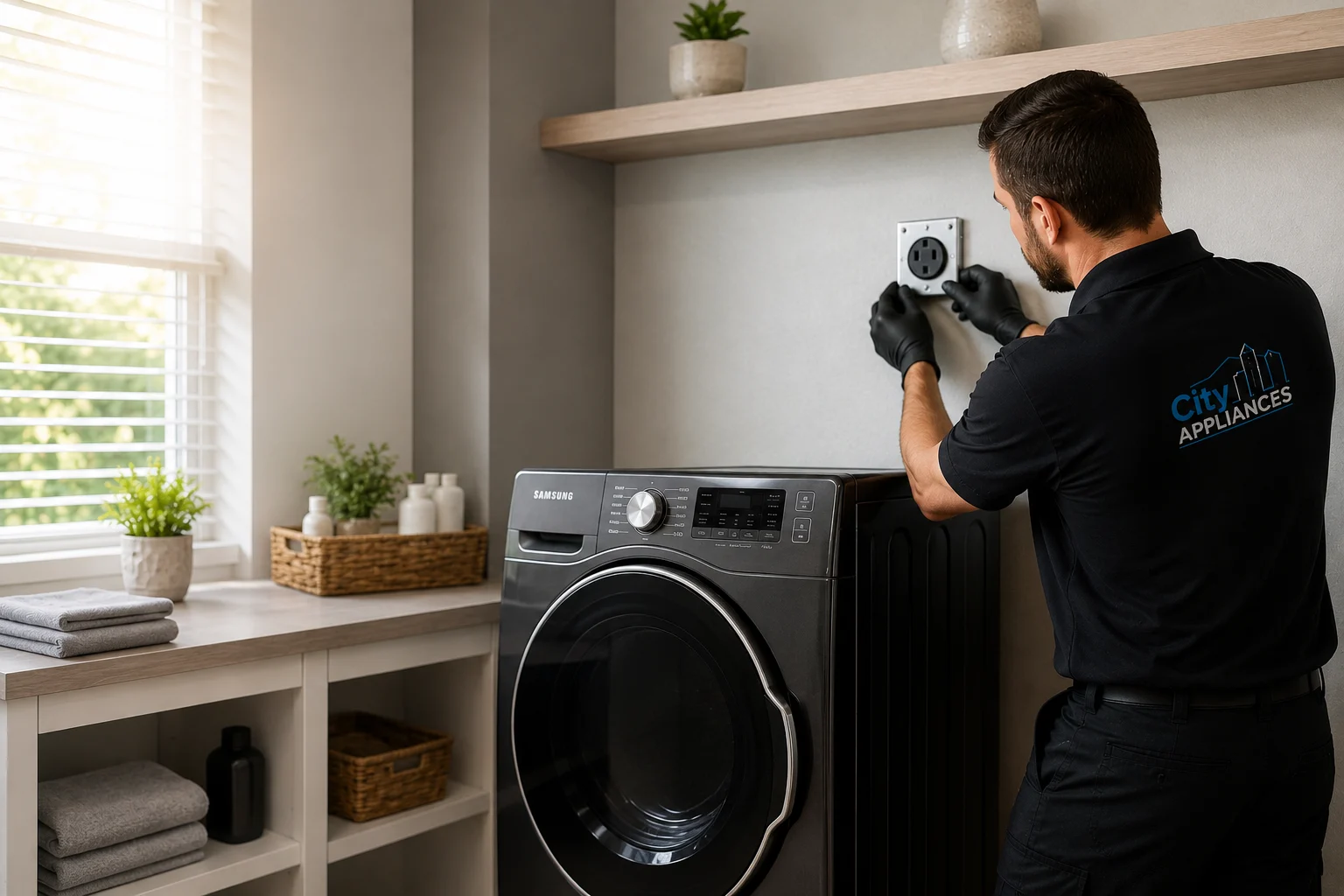
Yes. Every full-size electric dryer needs a dedicated 240-volt, 30-amp outlet. A regular 120-volt household outlet will not run one. The two exceptions are gas dryers, which use a standard outlet plus a gas line, and compact 110V portable dryers, which plug into any regular outlet. Before you buy, check what’s behind your current dryer.
TL;DR
- Full-size electric dryers run on 240V/30A. Plugging one into a regular outlet won’t work, and forcing it with an adapter is a fire risk.
- A 30-second look at your laundry outlet tells you exactly which dryers your home supports. Photos below show all three types.
- No 240V outlet? You can add one, switch to gas, or buy a 110V ventless dryer. City Appliances stocks all three options in Citrus Heights. Call or text (916) 501-6182.
Standing in a showroom or scrolling listings, the outlet question is easy to overlook. Then the delivery truck arrives and the plug doesn’t fit the wall. At City Appliances on Greenback Ln, we see this happen every month. This guide covers everything to check before you order, so your dryer works on day one.
The quick answer: which dryers need 240V and which don’t
Only full-size electric dryers need a 240V outlet. Here’s the full picture:
| Dryer type | Power needed | Works with a regular outlet? |
| Full-size electric dryer | 240V, 30-amp dedicated circuit | No |
| Gas dryer | 120V outlet + natural gas line | Yes (plus gas hookup) |
| Portable / ventless 110V dryer | Standard 110–120V outlet | Yes |
A gas dryer heats with burning gas and only uses electricity to spin the drum, so an ordinary plug is enough. A 110V portable dryer trades drying speed for the ability to run anywhere. Everything else in the full-size electric category, from basic Whirlpool top-loads to LG, GE, and Samsung electric dryers, needs 240 volts.
So the first real question isn’t which dryer to buy. It’s what outlet you already have.
How to tell what outlet you have (30-second check)
Look at the outlet behind your dryer, or where the old dryer sat. You’ll see one of three things:
- A regular wall outlet (two small vertical slots plus a round hole, same as your phone charger uses). This is 120V. It supports a gas dryer or a portable dryer only.
- A large 3-prong outlet (two angled slots and one L-shaped or round slot). This is a 240V NEMA 10-30, common in homes built before 1996. It runs a full-size electric dryer with a 3-prong cord.
- A large 4-prong outlet (two angled slots, one L-shaped slot, one round ground). This is a 240V NEMA 14-30, the modern standard. It runs a full-size electric dryer with a 4-prong cord.
If you’re not sure what you’re looking at, snap a photo and text it to us at (916) 501-6182. We match dryers to outlets every day and can tell you in one reply. The International Association of Certified Home Inspectors also keeps a reference gallery of 3-prong and 4-prong dryer outlets if you want a second visual.
One more source of confusion worth clearing up: 220 and 240 are the same thing here. Older electricians say 220V, modern nominal voltage is 240V, and homes may actually deliver 208 to 240 volts. Any dryer sold as 220V, 230V, or 240V uses the same outlet.
Knowing your outlet type matters because of what happens if you ignore it.
Why an electric dryer can’t run on a regular outlet
A full-size electric dryer draws roughly twice the voltage and far more current than a standard outlet delivers. The heating element alone needs the full 240V/30A circuit. Plug the machine into anything less and it simply won’t start, or worse, it trips breakers and overheats wiring.
You’ll find adapter cords online that claim to solve this. Don’t use them. Reddit and Facebook threads are full of workarounds like 4-to-3 prong adapters and DIY plug swaps, and licensed electricians consistently call them out as dangerous. An adapter doesn’t create the missing 240 volts or the dedicated circuit. It just moves the failure point somewhere you can’t see it.
There’s also a fire-safety angle that applies to every dryer, whatever the voltage: the U.S. Department of Energy recommends cleaning the lint screen after every load and inspecting the vent regularly because blocked airflow is a leading cause of dryer fires. A correct outlet plus a clear vent is the whole safety picture.
If your home does have a 240V outlet, the next thing to check is which of the two versions it is.
3-prong vs 4-prong: what your home’s age tells you
The split is simple: homes wired before 1996 usually have the older 3-prong (NEMA 10-30) outlet, and homes wired after have the 4-prong (NEMA 14-30). The National Electrical Code changed in 1996 to require a separate ground wire, which is the fourth prong. The Spruce’s guide to 3-prong and 4-prong dryer outlets covers the code history in detail, and confirms two things Citrus Heights buyers ask us constantly:
- You don’t have to upgrade a working 3-prong outlet. Code allows existing ones to stay in service.
- New installations must be 4-prong. No electrician will legally install a new 10-30 today.
Citrus Heights matters here because so much of the city’s housing was built in the 1970s and 80s, before the code change. If you’re buying a dryer for an older home near Greenback Ln, Sunrise Blvd, or Old Auburn Rd, there’s a good chance you have a 3-prong outlet, and that’s fine.
The fix is the cord, not the outlet. Dryer cords are swappable: the same machine takes a 3-prong or 4-prong cord depending on your wall. Which brings up a detail almost nobody warns you about before delivery day.
The cord isn’t in the box (and other delivery-day surprises)
New electric dryers ship without a power cord. Manufacturers do this on purpose because they can’t know whether your home needs the 3-prong or 4-prong version. Budget $20 to $30 for the correct cord, and make sure whoever delivers your dryer installs and tests it. The same applies if you’re saving money on a returned unit; our guide on whether an open box electric dryer is worth it covers the cord cost and what else to inspect.
At City Appliances, we include cord installation with delivery. Tell us your outlet type when you order (or text us that photo), and the dryer arrives with the right cord already fitted. Same-day delivery is available in the Citrus Heights area on most in-stock models when you order by 2 PM, and every used unit carries our 60-day in-home repair or replacement warranty.
No 240V outlet? Your three real options in Citrus Heights
You can still get a dryer this week. Here are the three paths, in order of what they cost and involve:
1. Buy a 110V ventless or portable dryer. No electrician, no gas line, no vent hole in the wall. These compact units plug into any standard outlet, dry a small load in 60 to 90 minutes, and typically run $150 to $450. They’re the practical answer for apartments, condos, and rentals where you can’t modify wiring. We stock compact apartment dryers with 110V ventless options at the Citrus Heights store, with same-day delivery on most models.
2. Install a 240V outlet. A licensed electrician runs a dedicated circuit from your panel. Cost guides like Angi put a basic 240V outlet install around $220 on average ($175 to $300), and it climbs toward $900 or more when the panel is far from the laundry area or needs upgrading. It’s the right long-term move if you own the home and want a full-size electric dryer. We’re happy to recommend local electricians we trust; permits in Citrus Heights are handled through the city’s building division, so ask your electrician to pull one.
3. Switch to gas. If your laundry area already has a gas line, a gas dryer plugs into the regular outlet you already have. Gas models cost a bit more upfront but heat faster per load. If there’s no existing gas line, running one usually costs more than option 2, so it only makes sense in homes already plumbed for it.
Renters and anyone who needs laundry working this week usually pick option 1. Homeowners planning to stay usually pick option 2. Either way, here’s the complete list of what to check before you order.
Buying a dryer in Citrus Heights: the pre-order checklist
Five checks prevent nearly every failed dryer delivery:
- Outlet: regular 120V, 3-prong 240V, or 4-prong 240V? (Photo-check section above.)
- Cord: ordered to match your outlet, $20 to $30, installed at delivery.
- Gas line: present or not? It decides whether gas is even an option.
- Vent path: full-size dryers need a duct to the outside. Ventless portables skip this entirely.
- Fit and path: measure the laundry space, doorways, and any tight corners. Standard dryers are 27 inches wide; compacts run 24. Tight closet? A used stackable washer dryer set solves the footprint, and the 240V rule works the same way for stacked units.
Bring your answers (or just the outlet photo) to us and the rest takes ten minutes. You can also browse new and refurbished dryers in Citrus Heights first to shortlist a model before checking your outlet against it.
Still have questions? These are the ones we hear most.
Ready to match a dryer to your outlet?
Bring the photo of your outlet to our showroom or send it over by text. We’re a local, family-owned, licensed appliance store with new, open box, and refurbished dryers, same-day delivery on most models, cord installation included, haul-away for your old unit, and financing up to $5,000 (open Mon–Sun, 8am–6pm). If the outlet question has been holding up your laundry room, it stops today. Get in touch and tell us what’s on your wall.
City Appliances
8038 Greenback Ln, Citrus Heights, CA 95610
📞 Call or text: (916) 501-6182
Find us on Google Maps: https://share.google/m9flWoSAxGTIJlQbi
Frequently asked questions
Q1: Can I plug my electric dryer into a regular outlet?
No. A full-size electric dryer needs a 240V, 30-amp outlet. A regular 120V outlet can’t power the heating element, and adapters that claim to bridge the gap are unsafe. Your regular-outlet options are a gas dryer or a 110V portable dryer.
Q2: Do all dryers need a 240V outlet?
No. Only full-size electric dryers do. Gas dryers use a standard 120V outlet plus a gas line, and compact 110V portable dryers plug into any household outlet.
Q3: Can I run a 220V dryer on 110V?
No. A dryer rated 220V or 240V will not run on a 110V outlet. At best nothing happens; at worst you trip breakers or damage the machine. 220V and 240V are the same standard, so any full-size electric dryer needs the large dryer outlet.
Q4: How do I know if my dryer outlet is 120 or 240 volts?
Look at the size and slot pattern. A 240V dryer outlet has three or four large slots. A 120V outlet is the small standard outlet the rest of your home uses. If your outlet matches your other wall outlets, it’s 120V.
Q5: Will a 3-prong dryer work with a 4-prong outlet?
Yes, after a cord swap. The dryer itself doesn’t care; you just fit a 4-prong cord to match the outlet. It’s a 10-minute job that City Appliances handles at delivery. Never use a plug adapter instead of swapping the cord.
Q6: Is a 4-to-3 prong dryer adapter safe?
No. Electricians consistently advise against them because they bypass the grounding design of the outlet. Swap the cord on the dryer instead. Cords cost $20 to $30, which is cheap insurance against a shock or fire hazard.
Q7: What is the most common outlet for a dryer?
The NEMA 14-30, the 4-prong 240V outlet, is the modern standard and required in all new installations since 1996. Older Citrus Heights homes often have the 3-prong NEMA 10-30, which is still legal to use.
Q8: Does a new dryer come with a cord?
No. Full-size electric dryers ship without a power cord because outlet types vary by home. Expect to add $20 to $30 for the right cord. Ask your seller to include and install it; we do this on every City Appliances delivery.
Q9: How much does it cost to install a 240V dryer outlet in Citrus Heights?
A basic install by a licensed electrician averages around $220, with a typical range of $175 to $300. Long wire runs or panel work can push the total toward $900 or beyond. Get two local quotes, and check whether a permit is required for your specific job.
Q10: Do gas dryers need a 240V outlet?
No. Gas dryers heat with natural gas and only use electricity for the drum and controls, so a standard 120V outlet is all they need, plus a connected gas line with a shutoff valve.