



5 things to inspect before buying a used gas dryer in Sacramento

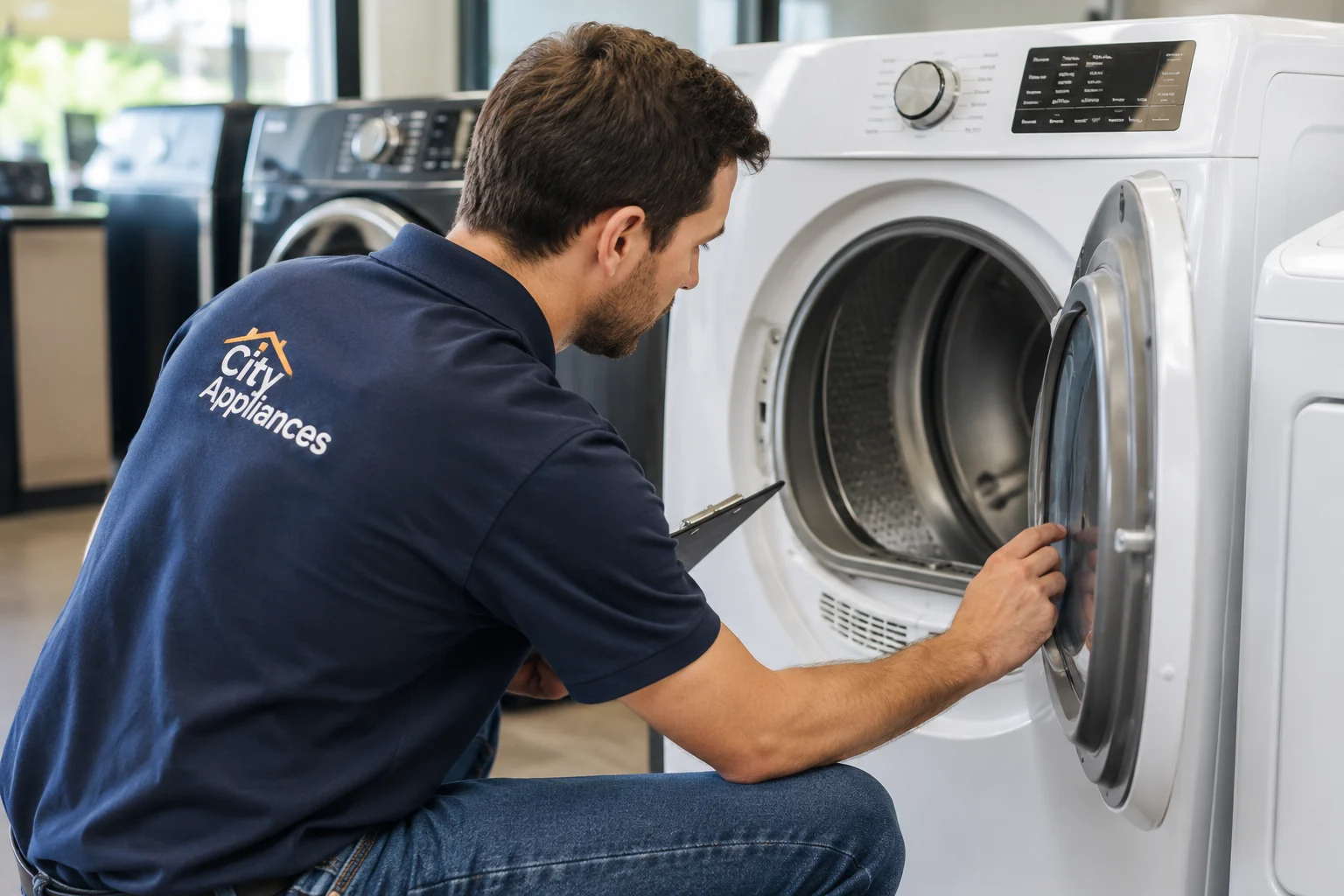
Before buying a used gas dryer in Sacramento, check the gas connector and shutoff valve for corrosion, watch the burner flame during a test run, confirm the drum spins smoothly, inspect the lint trap and vent path, and make sure your home already has a gas line. Skip any one of these and you’re buying blind.
Key takeaways
- A gas dryer’s biggest risks aren’t electrical — they’re the gas connector, the shutoff valve, and what color the flame burns when it lights.
- Lint buildup is a fire risk on any dryer, and it’s the leading cause of the roughly 2,900 residential dryer fires reported in the U.S. each year, according to the U.S. Fire Administration.
- A used gas dryer is only a good deal if your laundry area already has a gas line, since adding one can erase the savings.
- Want a specific unit checked before you buy? Call or text City Appliances at (916) 501-6182.
Check the gas connector and shutoff valve first
A used gas dryer’s connector should never be a reused one from a prior installation, and the shutoff valve should turn smoothly with no corrosion or gas smell around it.
This is the one check that has no equivalent on an electric dryer, and it’s also the one most buyers skip because it’s not obvious what to look for. Ask the seller whether the flexible gas connector is the one currently attached or a leftover from the last hookup. A connector should never be reused between installations, since the fittings and the flexible tubing itself degrade with age and repeated connection cycles. Look at the shutoff valve where the gas line meets the wall: it should turn with normal hand pressure, show no rust or corrosion around the fitting, and have no lingering smell of gas near the connection point. If you notice any smell at all, stop and don’t proceed with the purchase until it’s been checked by someone qualified. A loose, corroded, or reused connection is the kind of problem that doesn’t show up until the dryer is already running in your home, which is exactly why it has to be checked before the unit leaves the seller’s floor. Our own gas dryer hookup guide for Sacramento walks through exactly what a correct connector and shutoff setup should look like, including the leak-test step every new connection needs before it’s considered safe to run.
Watch the flame, not just whether it lights
A healthy gas burner flame is steady and blue. Yellow, orange, or flickering flame signals incomplete combustion, a safety issue electric dryers simply don’t have.
When a seller runs a test cycle for you, don’t just check that the dryer heats up. Watch the burner itself through the access panel or viewing slot if the model allows it. A properly functioning gas burner produces a flame that is mostly blue, burns steadily without flickering, and ignites promptly when the dryer calls for heat. A yellow or orange-tinged flame, a flame that flutters or jumps, or a burner that takes several seconds or multiple attempts to catch are all signs of a combustion problem, which can mean a dirty burner, an airflow issue, or a problem with the gas-air mixture. None of these are safe to ignore, because incomplete combustion from a gas appliance isn’t just an inefficiency problem, it’s a carbon monoxide risk. If a seller can’t or won’t run a live test cycle so you can watch the burner ignite, treat that as a reason to walk away rather than a detail to overlook, the same standard you’d apply to any used appliance you can’t verify in person.
Spin the drum and check for the same wear signs as any dryer
The drum, rollers, and belt wear the same way on a gas dryer as they do on an electric one, so spin the drum by hand and listen for grinding, thumping, or resistance before you buy.
This part of the inspection isn’t fuel-specific. Gas and electric dryers share the same drum, support rollers, and drive belt, and those components fail the same way regardless of what heats the air. A drum that spins smoothly with no noise is a good sign. Grinding or scraping usually points to worn rollers, thumping often means a flat spot or imbalance, and a loose or slipping feel can mean a worn belt. Because this mechanical check applies equally to electric dryers, we’ve already covered it in more depth, including the full seven-point version, in our guide to buying a used electric dryer in Sacramento — worth a read if you’re cross-shopping gas against electric and want the complete mechanical checklist in one place.
Inspect the lint trap and vent path — the fire-risk check
Residential clothes dryers cause thousands of home structure fires every year, and according to the U.S. Fire Administration‘s report on clothes dryer fires, “failure to clean” is the leading operational deficiency behind them, with an estimated $88 million in annual property loss. A used gas dryer’s vent history is rarely something a seller can tell you much about.
Pull the lint trap out and check it for tears, heavy residue, or a musty smell, then look past the trap itself into the lint housing with a flashlight. Buildup inside the housing, not just in the removable trap, is both a performance problem and the specific fire-risk point the U.S. Fire Administration’s data points to: failure to clean is the leading ignition factor behind dryer fires, accounting for roughly a third of them in the agency’s most recent published analysis. On a used dryer, you’re also inheriting whatever vent setup the previous owner had, so ask what kind of ducting was used. Rigid or semi-rigid metal venting is the only safe option; flexible plastic or foil ducting traps lint more easily and is a known fire hazard, a point our gas dryer hookup guide covers in detail if you’re setting up venting for the first time rather than reusing an existing run. A clean trap with a visibly caked housing or an unknown vent material is a sign the unit wasn’t well maintained, even if it looks fine on the outside.
Confirm your home actually has a gas line before you buy
A used gas dryer is only a good deal if your laundry area already has a gas line and shutoff valve in place — otherwise the cost of adding one can erase the savings you’re getting on the appliance itself.
Before you fall in love with a price on a used gas dryer, check your own laundry space first. Look for an existing gas line and shutoff valve within a few feet of where the dryer will sit. If it’s already there, you’re mainly paying for the connector, the leak test, and delivery. If it isn’t, running a new gas line typically costs $200 to $600 in the Citrus Heights area for the line alone, based on our own installation pricing, and that’s before the dryer itself. A $300 used gas dryer stops being a bargain once you add a few hundred dollars in gas line work a comparable used electric model wouldn’t need. This is worth checking before you shop, not after you’ve already picked a unit. Once you know your hookup situation, you can browse City Appliances’ current gas dryer selection knowing exactly what you’re working with.
Ready to find your gas dryer?
Whether it’s the connector, the flame, or the vent that worries you most, the real question is the same: was this specific unit actually tested, and is there a real warranty behind it. Browse our current gas dryer selection to see what’s in stock this week, already inspected and ready to go. Call or text us at (916) 501-6182, and we’ll tell you exactly what was checked before it hit the floor.
City Appliances
8038 Greenback Ln, Citrus Heights, CA 95610
Call: +1 916-501-6182
Find us on Google Maps: https://share.google/m9flWoSAxGTIJlQbi
Frequently asked questions
Q1: Is it okay to buy a used dryer?
Yes, as long as it’s been tested and you’ve checked it yourself using something like the five points above. The risk isn’t in buying used, it’s in buying untested. A gas dryer that passes the connector, flame, drum, and vent checks carries a fraction of the risk of one you can’t inspect in person.
Q2: What dryer brands should I stay away from?
There’s no brand that deserves a blanket “avoid it” label. Mainstream brands are all widely serviced with available parts in the Sacramento area. The bigger risk is an untested unit from a seller who can’t tell you what was checked, regardless of what name is on the front.
Q3: How can I test a dryer before buying it?
Ask the seller to run a full cycle while you watch. For a gas model, that means confirming the burner ignites promptly with a steady blue flame, the drum turns smoothly without noise, and the unit produces real heat within the first couple of minutes. If a seller won’t let you watch a live test, that’s reason enough to look elsewhere.
Q4: Do gas dryers need a 240V outlet?
No. A gas dryer runs on a standard 120V outlet, since electricity only powers the drum motor and controls while the gas line supplies the heat. That’s the opposite of a full-size electric dryer, which needs a dedicated 240V circuit.
Q5: Is a gas dryer better than an electric dryer for a used purchase?
Neither is universally better, and for a used buy the better question is which one matches what your home already has. A gas dryer only makes sense as a used purchase if you already have a gas line, since adding one changes the math. An electric dryer needs a 240V outlet instead, no gas line required. The appliance itself isn’t the deciding factor, your home’s existing hookup is.
Q6: What’s the 50/50 rule for appliances?
It’s a rough guideline for deciding between repairing and replacing: if a repair would cost more than half of what a comparable replacement costs, replacement is usually the better value. It applies to a used dryer too, once you’re a few years in and weighing whether a repair is worth it.