



Over-the-range microwave in Citrus Heights: does it actually replace your range hood?

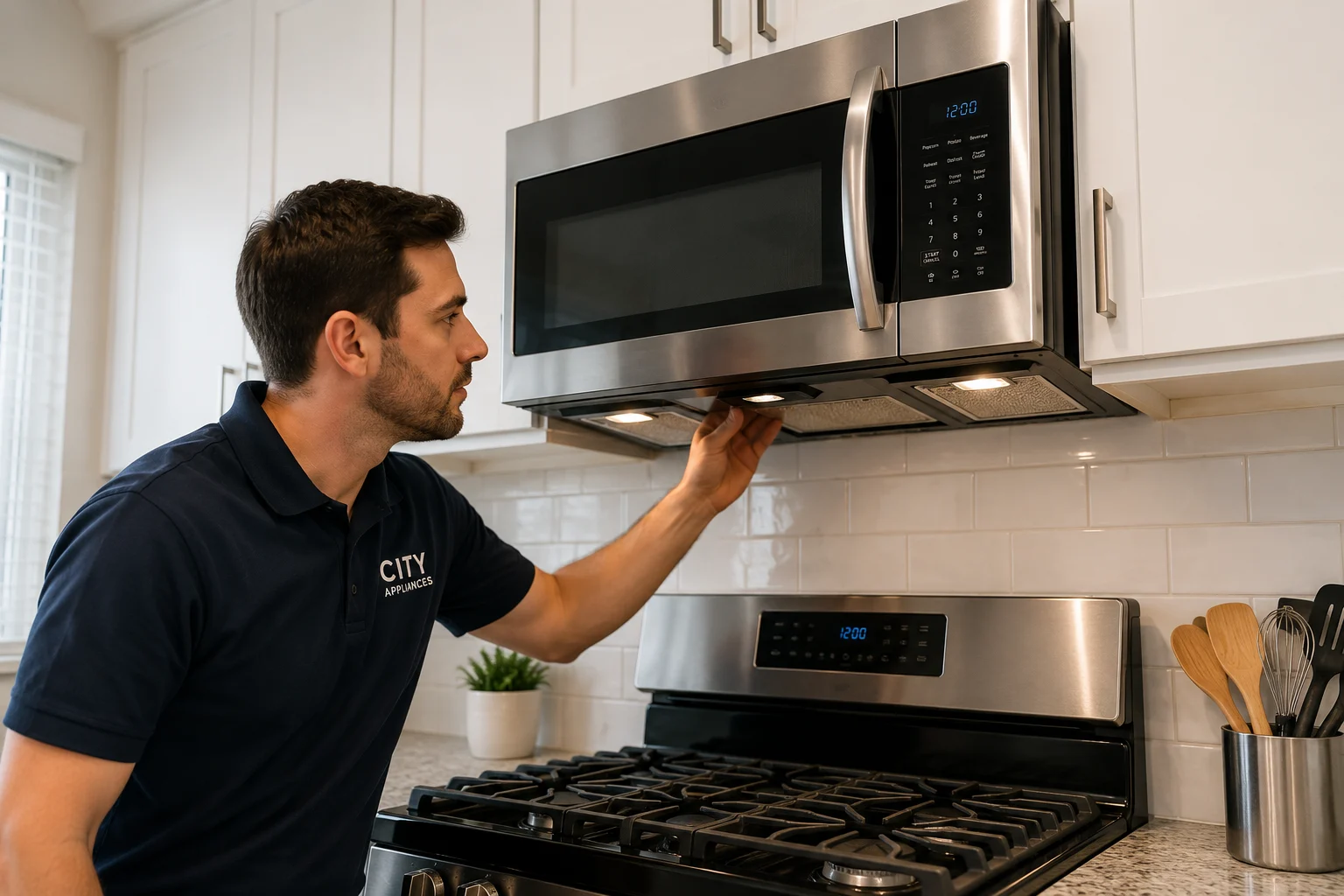
An over-the-range microwave can technically replace a range hood, since both mount above the cooktop and pull air out of the kitchen. It falls short functionally, though: most over-the-range units move 150 to 310 CFM of air, while a dedicated range hood moves 300 to 1,500 CFM. If you cook often, especially with a gas range or a wok, that gap matters.
Key takeaways
- An OTR microwave vents air, but at roughly half the power of a dedicated range hood in most cases
- Dedicated range hoods run 300 to 1,500 CFM; OTR microwaves typically run 150 to 310 CFM, according to Yale Appliance
- Installing an OTR microwave in Citrus Heights runs cheaper than adding a vented range hood, mainly because of ductwork
- You need 24 to 30 inches of clearance above the cooktop and a dedicated 110 to 120V outlet before installing either one
- Light, occasional cooks are usually fine with an OTR microwave; daily or heavy cooks (searing, frying, wok cooking) notice the difference
- City Appliances carries new, open-box, and scratch-and-dent OTR microwaves, and installs them with a flat $50 old-unit removal fee
Table of contents
- What’s the difference between a range hood and an over-the-range microwave?
- How much less ventilation power does an over-the-range microwave actually have?
- When is an OTR microwave good enough in a Citrus Heights kitchen, and when isn’t it?
- What duch does it cost in Citrus Heights and Sacramento?
- Shoulo you need before installing an over-the-range microwave?
- How md you buy new, used, or scratch-and-dent?
- Where can you buy or install an over-the-range microwave in Citrus Heights?
- FAQ
What’s the difference between a range hood and an over-the-range microwave?
A range hood is built for one job: pulling smoke, grease, and steam away from your cooktop. An over-the-range (OTR) microwave does two jobs at once, cooking and venting, which means neither job gets the full design attention a dedicated appliance gets.
Both types come in two venting styles. A ducted (vented) unit pushes air outside through a duct in the wall or roof. A ductless (recirculating) unit pulls air through a charcoal filter and blows it back into the kitchen, which filters grease but not heat, moisture, or odor as effectively.
Most OTR microwaves ship as recirculating units unless you specifically order a ducted kit, while most dedicated range hoods sold in Citrus Heights are ducted by default. That single difference explains most of the ventilation gap covered in the next section. If you’re also weighing whether a smaller microwave belongs on your counter instead of over your range, City Appliances covers that separately in can a countertop microwave be installed as a built-in?
How much less ventilation power does an over-the-range microwave actually have?
An over-the-range microwave typically moves 150 to 310 CFM of air, compared to 300 to 1,500 CFM for a dedicated range hood, according to Yale Appliance’s ventilation comparison. That means a standard range hood can move two to five times more air than the exhaust fan built into most OTR units.
Broan-NuTone recommends roughly 10 CFM of ventilation for every 1,000 BTUs your burners put out. A typical four-burner gas range in the 30,000 to 40,000 BTU range calls for 300 to 400 CFM, which sits right at or above what most OTR microwaves can deliver, even before you factor in real-world airflow loss from ductwork bends and filter buildup.
| Appliance type | Typical CFM range | Vent style |
| Over-the-range microwave | 150–310 CFM | Usually ductless (recirculating) unless ordered ducted |
| Dedicated range hood | 300–1,500 CFM | Usually ducted |
The Range Hoods City Appliances carries include under-cabinet, wall-mounted, insert, and island models, so if the CFM math above tells you an OTR microwave won’t keep up with your cooking, there’s a dedicated option to step up to without a full kitchen remodel.
When is an OTR microwave good enough in a Citrus Heights kitchen, and when isn’t it?
An OTR microwave is good enough if you cook a few times a week, mostly boil, bake, or use lower heat, and don’t run a gas range at high output regularly. It falls short if you cook daily, sear or stir-fry often, or cook with a gas range that puts out real heat and steam.
Is a microwave over the stove outdated? Not exactly. It’s still the most space-efficient option for a small Citrus Heights kitchen, since it eliminates the need for separate microwave and hood real estate. The tradeoff is ventilation power, not relevance.
The real disadvantages show up in daily use: OTR microwaves sit lower over the burners than most hoods (extending roughly 16 inches out rather than the deeper reach of a dedicated hood), so front burners often get less coverage. Grease filters clog faster relative to their smaller motor, and recirculating models don’t remove heat or humidity the way a ducted hood does. If your kitchen runs hot and steamy every time you cook, that’s your signal to look at a dedicated range hood instead.
What do you need before installing an over-the-range microwave?
Before installing an OTR microwave, confirm four things: cabinet clearance, cabinet weight support, electrical, and venting path.
- Clearance: 24 to 30 inches between the cooktop surface and the bottom of the microwave, matching standard range hood clearance guidance
- Weight support: your upper cabinet needs to support 50 to 70 pounds, since that’s the typical loaded weight of an OTR unit
- Electrical: a dedicated 110 to 120V grounded outlet inside the cabinet; older homes with only a basic wired range hood may need an electrician to add one
- Venting: decide between ducted (vents outside through wall or roof) or ductless (recirculates through a charcoal filter) before you buy, since not every unit supports both
If your cabinet layout was built around a smaller countertop unit, the built-in trim-kit compatibility questions get more involved. City Appliances walks through cutout sizing and clearance in can a countertop microwave be installed as a built-in?, which covers the same clearance and mounting logic from a different angle.
How much does it cost in Citrus Heights and Sacramento?
Installing an OTR microwave costs less than adding a new vented range hood in most Citrus Heights kitchens, mainly because a range hood often requires new ductwork.
| Project | Typical cost |
| OTR microwave, unit + installation | $250–$1,200, according to Angi’s 2026 microwave installation data |
| Range hood installation (nationally, ductwork included) | $650–$2,500, average $1,750, according to Angi’s 2026 range hood installation data |
| Old unit removal at City Appliances | $50 flat fee |
That range hood figure runs higher mainly because of ductwork. Angi’s data shows a ducted range hood installation with new ductwork lands near the top of that range, since cutting a new vent path through a wall or roof and adding a damper adds real labor on top of the hood itself. An OTR microwave swap into an existing cabinet opening usually skips most of that work, which is why it’s the cheaper of the two options for most Citrus Heights homeowners upgrading from a basic hood.
City Appliances includes professional mounting and electrical connection with every OTR microwave installation, plus a flat $50 fee to remove your old unit, so the number above isn’t just a national estimate. It’s what you’ll actually pay locally on top of the unit itself.
Should you buy new, used, or scratch-and-dent?
Buy scratch-and-dent or open-box if the ventilation numbers above tell you an OTR microwave fits your cooking habits, since the discount on a cosmetic-only unit is the same whether it vents well or not. City Appliances’ scratch-and-dent buying guide shows savings of 30 to 60% off retail across appliance categories, and that discount band applies the same way to over-the-range microwaves as it does to dryers and ranges.
City Appliances stocks new, open-box, and scratch-and-dent OTR microwaves from LG, GE, Whirlpool, Bosch, Miele, Samsung, KitchenAid, Maytag, Amana, Hotpoint, Thermador, Danby, Fisher & Paykel, Electrolux, and Frigidaire. A scratch-and-dent unit is mechanically identical to new, with cosmetic shipping marks that don’t touch the motor, magnetron, or exhaust fan, so the CFM performance you read about in the section above doesn’t change based on condition.
If you’re replacing a unit that’s already vented through the wall, buying used or scratch-and-dent in the same size class also means you can often reuse your existing ductwork, which keeps your total cost closer to the microwave-only end of the range in the cost table above.
Where can you buy or install an over-the-range microwave in Citrus Heights?
City Appliances, at 8038 Greenback Ln in Citrus Heights, stocks OTR microwaves across all three condition tiers and installs what you buy. Browse the current selection on the Microwave page, or stop by to check your cabinet clearance and outlet setup in person before you commit to a specific model.
If the CFM comparison above pushed you toward a dedicated range hood instead, the same team carries under-cabinet, wall-mounted, insert, and island range hoods on the Range Hoods page, so you can compare both categories side by side rather than guessing from spec sheets alone.
The bottom line
An over-the-range microwave replaces a range hood in the sense that both mount above your cooktop and vent air out of the kitchen. It doesn’t match a dedicated hood’s ventilation power, especially if you cook often or run a gas range at real heat. Match the appliance to how you actually cook, not just to what fits the cabinet opening.
Ready to see both options in person?
Stop by City Appliances and we’ll check your cabinet clearance, outlet, and venting setup, then show you OTR microwaves and range hoods side by side, new, open-box, or scratch-and-dent. Schedule a visit or stop by, no appointment needed.
City Appliances
8038 Greenback Ln, Citrus Heights, CA 95610
Call or text: (916) 501-6182
Find us on Google Maps: https://share.google/m9flWoSAxGTIJlQbi
FAQ
Q1: Can you replace a range hood with an over-the-range microwave?
Yes, physically. Most cabinet openings sized for a range hood can accept an OTR microwave with the right trim kit, as long as you have the clearance, weight support, and electrical outlet it needs. The tradeoff is ventilation power, not fit.
Q2: Is a range hood better than an OTR microwave?
For ventilation, yes. A dedicated range hood moves 300 to 1,500 CFM against 150 to 310 CFM for a typical OTR microwave, according to Yale Appliance’s comparison. For counter space and simplicity, an OTR microwave wins since it combines two appliances in one footprint.
Q3: Does a microwave hood have to vent outside?
No. Most OTR microwaves ship as recirculating (ductless) units that filter air through a charcoal filter and blow it back into the kitchen. You can order a ducted version if your cabinet already has a vent path to the outside.
Q4: How much CFM does my range hood need?
Roughly 10 CFM per 1,000 BTUs of burner output, per Broan-NuTone’s ventilation guidance. A standard 30,000 to 40,000 BTU gas range calls for about 300 to 400 CFM, which is at the upper end or beyond what most OTR microwaves deliver.
Q5: Is a microwave over the stove outdated?
No, it’s still a common and space-efficient setup, especially in smaller Citrus Heights kitchens. It’s a ventilation tradeoff, not an outdated design.
Q6: How much does it cost to install an over-the-range microwave in Citrus Heights?
Typically $250 to $1,200 for the unit and installation, based on Angi’s national data, plus City Appliances’ flat $50 fee to remove your old unit. That’s usually cheaper than adding a new vented range hood, which averages $1,750 and can run up to $2,500 once new ductwork is involved.
Q7: Can you buy a used or scratch-and-dent over-the-range microwave?
Yes. City Appliances carries scratch-and-dent and open-box OTR microwaves at 30 to 60% off retail, the same discount range as the rest of its scratch-and-dent inventory. Cosmetic marks don’t affect the motor or exhaust fan.